Jumat, 20 Mei 2016

Roasted at Home

Roasting of coffee is one of the most important processes on the way of its transformation from berry to a perfect drink. Among coffee fanciers there are those who prefer coffee of dark roasting. Such coffee has a slight bitterness, that invigorates. There are also those who prefer coffee of light roasting that gives a bit of sourness and fine aroma.
Coffee gourmets and simply those who like coffee as it is, more often roast coffee at home. It is explained by the fact that one has the possibility to control the process of roasting. You can choose coffee grades from all over the world, control the time of roasting and set your own standards of light, medium and dark roasting. But you have to remember that it's impossible to get such quality of coffee while roasting at home as you can get due to industrial production. It is difficult to get guarantee qualitive roasting inside and outside the bean at home, because of lack of necessary technologies.
Before you start your experimental home roasting be ready to spoil the first portion but don't be upset, practise makes perfect. You'll spoil not one kg of coffee on the way to perfection.
It is better to roast coffee in a cast-iron pan, as in the oven it roasts unevenly and needs to be stired very often. Before roasting wash the pan assiduously to make away with all unnecessary scents that can spoil coffee aroma. At first green beans are washed and dried out. You can drain them in a natural way - on the air or you can wipe them with a towel.
Heat the pan beforehand, strew coffee in a thin layer and roast on a slow feeble fire. Gradually increasing the fire maximize it. Don't laze always to stir it in order the beans were evenly "covered with a tan". Some coffee lovers in the process of roasting add butter or oil on the assumption 1 tablespoon on half a kg of coffee. Than the coffee is more fragrant but it is preserved worse.
The time of roasting depends on quantity of beans, on thickness of a layer, on power of heat and even on the grade of coffee. Some people think that one should roast coffee beans till they get the colour of chestnut. When beans start to crackle they discharge oil that means that you can take the pan off the fire. When you've finished roasting get coffee out the pan and dry it on air for nearly 5 hours. Then put it into capacity where you'll keep coffee. After roasting at home beans get different hues but it won't influence the qualityof coffee essentially.
Green coffee beans may be kept for years. And roasted coffee better to use right after roasting. That is the advantage of roasting at home - you can always have at hand fresh coffee. Experimenting with roasting you can find the best stage of roasting coffee for yourself. You can even create new mixes.

Kamis, 12 Mei 2016

Coffee Roasting

Coffee beans’ roasting is possible even in home conditions: in an oven on oiled cast-iron or iron frying pans for about an hour. Such home roasting demands big experience and attention. It is important that the internal part of coffee beans turns out fried thoroughly and the external part at the same time doesn’t burn. Coffee roasted in home conditions is of poor quality and it is difficult to compare it with professionally roasted coffee. In coffee industry coffee is roasted in four various ways: thermal (contact and convective), dielectric, radiative and by infrared rays.
The oldest is the thermal contact way of roasting when heated metal drum walls transfer warm to coffee beans creating magic taste and aroma. Such way has not found wide application, especially after appearance of convective devices in coffeeprocessing enterprises in Brazil and the USA in 1935. The current of air heated to 200 degrees in such devices paints coffee beans in chestnut colour, and different grades of coffee leads up to different degree of darkness at that. In drums fragrant beans are roasted not definitively but get only soft brown colouring allowing coffee beans to "come" at the expense of own heat. Thus uniformity of roasting is provided; beans do not contain impurity and get a brilliant surface.
At roasting by dielectric way microwave energy is used. As waves of ultrahigh frequencies are capable to get evenly deep into coffee beans irrespective of their size, balanced homogeneous taste is characteristic to the beans roasted in such a way. Such features of microwave energy allow making the roasting process continuous and faster, and coffee contains the maximum quantity of extractive substances.
The USA was the first to begin experiment application of radiating energy in coffee manufacturing. As a rule, roasting by means of such energy (in a scientifically way - energy of ionising radiation) was used for the combined ways of manufacture - at first coffee beans are examined with gamma rays, and then are roasted on standard technologies of thermal processing - but already in a shorter period of time.
As a way in manufacture infra-red rays are also applied. For each grade of coffee optimum roasting modes are figured out - temperature and time combination. And time intervals are estimated in minutes and even seconds. Sometimes superfluous seconds can become critical – beans char and lose the valuable properties.
In the course of thermal processing coffee beans increase in size but simultaneously lose flesh about 20 percent at the expense of evaporation of water, combustion of extraneous particles and decomposition of some substances. But at roasting a new element - cafeol is born – it allows us to enjoy fine aroma of roasted coffee.
There are some steps of roasting:
Not roasted:
Properties of coffee - Raw beans, 12 % humidity.Temperature, ºС - roomSigns - Green (pale-grey with a greenish shade) and smooth.
Brown:
Properties of coffee - Steam release forces a bean to extend.Loss of weight, % - 13,0Temperature, ºС - 93-135ºSigns - Light brown colour. Light taste saturation, weak aroma with a bread smell. Absence of oil on a surface.
American:
Properties of coffee - Beans continue to increase in size. The first “crack” is audible. The acid maintenance is bigger than sugar.Loss of weight, % - 14,0Temperature, ºС - 168-190ºSigns - Moderate light brown colour, with a dry surface, bit of sourness. Increase in size.
City:
Properties of coffee - Strong increase in bean. The stage of «the first crack» comes to an end.Loss of weight, % - 15,0Temperature, ºС - 198-218ºSigns - Beans crack because of the allocated gases.
Full City:
Properties of coffee - Beans strongly increase in size. Balance of acids and sugar. The stage of «the second crack» beginsLoss of weight, % - 16,5Temperature, ºС - 223-229ºSigns - Brown colour of an average saturation, basically with a dry surface, with oil traces. Balanced acidity, full saturation of taste.
Viennese:
Properties of coffee - The gas most part is lost., the stage of «the second crack» comes to the end.Loss of weight, % - 17,0Temperature, ºС - 229-235ºSigns - Bright brown colour, occurrence of drops of oil on surfaces, sweetish-bitter tones of taste. Muffled acidity, strong saturation.
Espresso:
Properties of coffee - Aroma reduction, sugar caramelization.Loss of weight, % - 18,0Temperature, ºС - 235-240ºSigns - Dark brilliant surface with oil stains. Sweetish-bitter taste dominates. Acidity is muffled.
French:
Properties of coffee - Radical reduction of acidity, sugar caramelization.Loss of weight, % - 19,0Temperature, ºС - 240-246ºSigns - Dark black colour, beans are covered by oil. A smell of burnt oil. Distinctions, characteristic for green coffee are completely muffled. Bitter - sweet-bitter taste dominates.
Italian:
Properties of coffee - The bean loses characteristic aroma of coffee.Loss of weight, % - 20,0Temperature, ºС - 246-262ºSigns - Black, dry brilliant surface. Burnt bitter taste dominates.

Senin, 18 April 2016

Espresso


             Description
Concentrated beverage brewed by forcing nearly boiling wate runder pressure with ground coffee. Espresso has more caffeine per unit volume than most beverages.
The World “shot” is most commonly used as the basic unit of measurement in cafes and restaurants. People used term “shot of espresso”. A solo shot is usually 1 ounce of espresso, doppio is most often used for a double shot, and triplo for a triple shot.
A Professional operator of an espresso maschine is called barista, which is Italian for bartender.
            Perfect Pull
Freshness: Freshly roasted coffee beans ( i.e. within 4 days of being roasted) will create more bubbles when pulling a shot. This makes a shot run slower when pulled causing less taste. Old roasted beans (i.e. after 14 days of being roasted) will taste flat with less aroma. The optimal range for most espresso shots is 1 to 2 weeks after being roasted.
Speed: If you notice that your shot speeds vary dramatically from one shot to another, it may be a sign of inconsistent doses. Check to make sure you use the same amount of grounded coffee beans for each shot for a more consistent speed.
Taste: If you notice that even with proper speed and amount your shots are tasting bad, it may be a good sign to clean your maschine.
            Variation
Dose: The amount of coffee used for a shot espresso. An example for a single shot is 18g.
Time: The time it takes to pull a shot of espresso is usually 20-30 seconds long.
Grind: Having your grinds too long may results in longer extraction time. Having your grinds too coarse or low dose may results in shorter extraction.

Pulling: Action of making a shot of espresso.

Rabu, 13 April 2016

V60 Coffee Drip

Background
Arguably the simplest and cleanest way to draw out a coffee’s best qualities, the pour-over method is elegant without being prohibitively difficult. For those accustomed to coffee from a drip machine, this method will produce something similar but noticeably more delicate and complex.
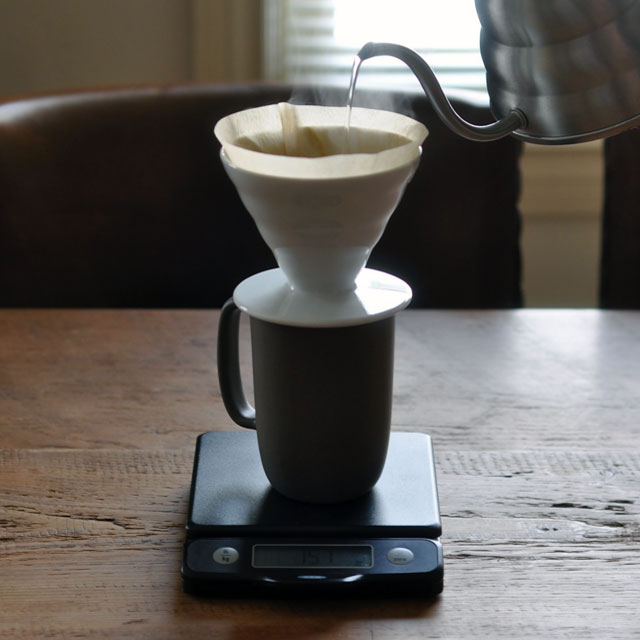
What You'll Need: Coffee,, Dripper,, Filter,, Grinder,, Kettle,, Scale,, Timer
Step 1
Bring to a boil twice as much water as you’ll need for the actual brewing (around 800 - 1000 ml).


Step 2
Weigh out about 25 grams of coffee (or approximately two to three tablespoons of whole beans).
*Ratio Water and Coffee are 1 : 15 (meaning 15 ml Water for 1 Gram Beans)
*Grind your coffee, the coarseness should be close to that of sea salt.


Step 3

Place a flask or something to catch the coffee on your scale. Next put the dripper on top of the flask.

Step 4
Prepare filter into the dripper, you’ll notice that it’ll stick out. Once your Water is finished boiling, pour the hot Water on the paper filter so it becomes wet and sticks to the dripper, The goal is to wet the paper and to get the paper taste out.

Step 5

In Order to track how much water to use for the next step, zero out the scale.
Add 25 gram the freshly grounded coffee into the dripper, Shake the dripper a little so the grounded coffee lies flat.


Step 6
Gently and slowly drizzle a small amount of hot water in the center of the mound of coffee, The goal is to pur enough the wet coffee without letting any drip. Start with inner the circle and work your way outward.

Step 7
First step wait the blooming process , where we will wait 45 second to let the coffee grinds bloom.
Second resume pouring on circular motion until scale reads the amount of water will match your preferred ratio. Here I used ratio 1 :15 in case for 25 Gram Beans the Water is 375 ml.
Try to pour at a rate that makes this step complete in about 2 and half minutes.


Step 8
Serve Immediately the total weight is reached, remove the dripper and pour the contents of the flask into your cup.

Enjoy your caffeine !!


Rabu, 09 September 2015


Arabica and Robusta between Majority and Minority

        The first article will discuss about Arabica and Robusta :

Arabica (Coffea arabica) is growing in altitude 700-1700 meters above sea level,the temperature of 16-20 ° C, dry climates three months in a row. Arabica coffee is sensitive
to leaf rust disease Hemileia Vastatrix (HV), especially when planted in the area with less elevation of 700 meters above sea level.

Coffee from Brazil and Ethiopia have controlled 70% of the world coffee market. Coffee arabica has many varieties, depending on the country, the climate, and the land where coffee is grown. We could find Toraja coffee, Mandailing, Columbian, brasilia, and so forth. Between Arabica coffee and the other one had a difference in taste.

Robusta coffee is a descendant of some species, especially Coffea canephora. Grows well in the altitude of 400-700 m above sea level, the temperature of 21-24 ° C with 3-4 dry months in a row and 3-4 times the rain submissions. Fruit quality is lower than Arabica and Liberika.

Control 30% world market. This coffee spread beyond Colombia, such as in Indonesia and The Philippines. Just like arabica, soil conditions, climate, and this coffee packaging process will different for each country and produce much less to taste different.